Worked examples#
Full-size simulations of experimentally motivated configurations, each run to the length its physics needs and
explained from the set-up to what to look for in the result. Unlike the focused
demonstrations, these are not executed when the documentation
is built: they take from seconds to a few hours each, so the pages, figures and
printed output below are the stored result of their last run, and every page ends with
the time that run took and the backend it used. To run one yourself, download the script
from its page; to re-run and refresh them all in a checkout, use
uv run poe docs-examples (see Contributing to solprop).
Nonlinear processes in gas-filled hollow-core fibres#
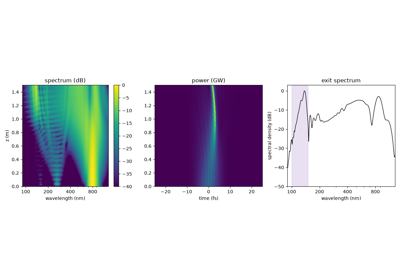
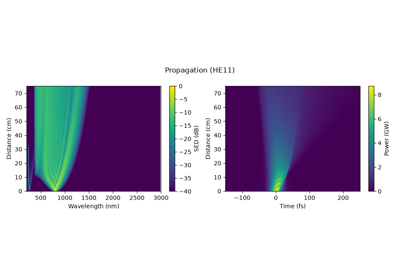
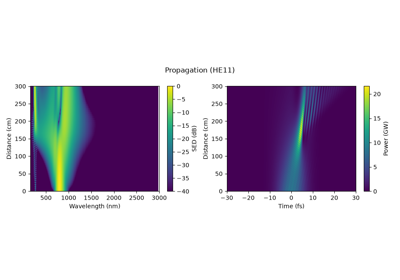
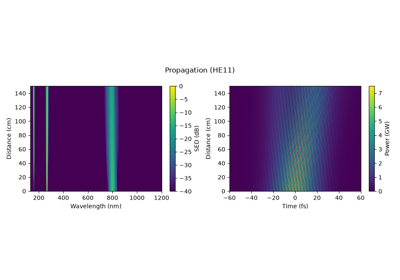
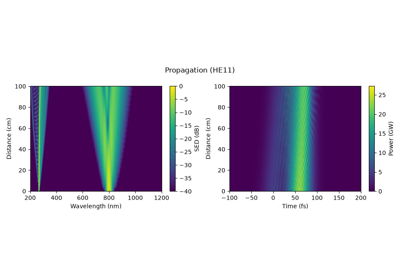
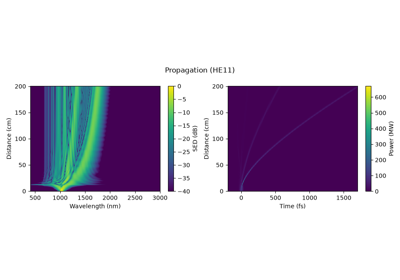
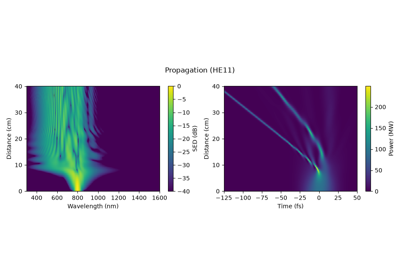
One process per example – self-phase modulation, soliton self-compression and dispersive-wave emission, four-wave mixing, cross-phase modulation, Raman and photoionisation-induced soliton frequency shifts – each a single deterministic run with the parameters of the survey figure in J. C. Travers, T. Grigorova, C. Brahms and F. Belli’s review of nonlinear optics in gas-filled hollow-core fibres, headed by the vacuum-ultraviolet dispersive wave that illustrates this package’s README. The last two compare the electronic responses of A frequency-dependent electronic response at full size: the helium dispersive wave, with one, two and four modes, and deep-ultraviolet four-wave mixing in argon over a pressure scan.
Vacuum-ultraviolet dispersive-wave emission in a gas-filled capillary
Soliton self-compression and ultraviolet dispersive-wave emission
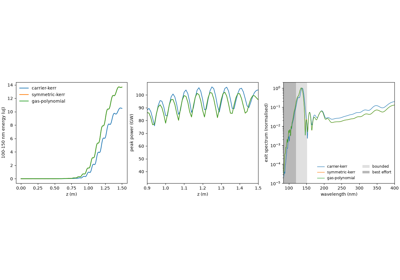
The vacuum-ultraviolet dispersive wave under a frequency-dependent Kerr response
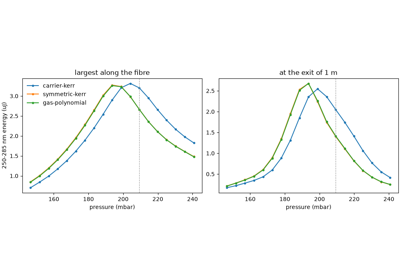
Deep-ultraviolet four-wave mixing in argon under a frequency-dependent Kerr response
Supercontinuum generation#
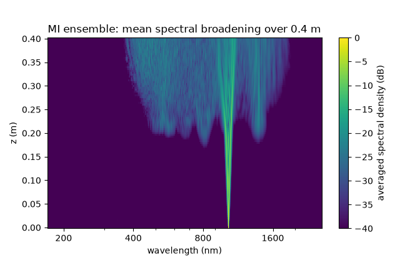
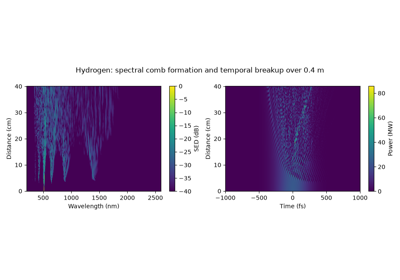
The four mechanisms of supercontinuum generation in gas-filled hollow-core fibres – self-phase modulation, soliton self-compression and dispersive-wave emission, modulational instability, and Raman comb-to-continuum – with ensembles of noisy shots for the averaged spectrum, its relative intensity noise and its first-order coherence. The MI ensemble uses eight seeded shots over 0.4 m; the Raman comb-to-continuum example uses one seeded shot over 0.4 m and does not estimate ensemble coherence. The SPM and soliton examples use twenty shots. Measured runtimes and backends are reported on the individual pages; they depend on the problem and machine.
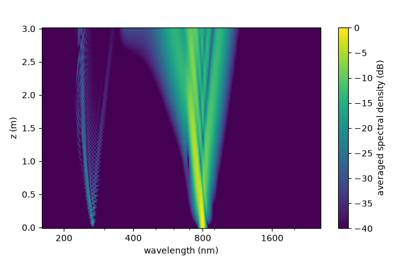
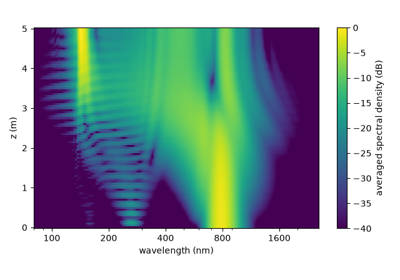
Supercontinuum by soliton self-compression, reaching the vacuum ultraviolet
Waveguide physics#
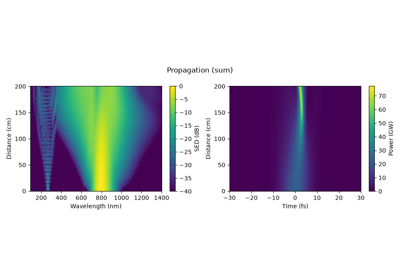
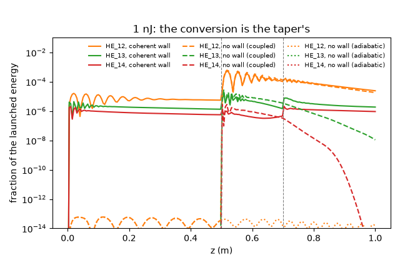
Pressure-gradient compressors with a coherent capillary wall, mode conversion in tapers, the vector wall, multimode graded-index fibres, a moving solid guide and a planar compressor.
A tapered capillary: compression, a dispersive wave and mode conversion
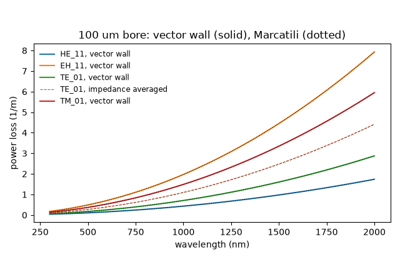
Radially and azimuthally polarised pulses: the vector wall over a metre
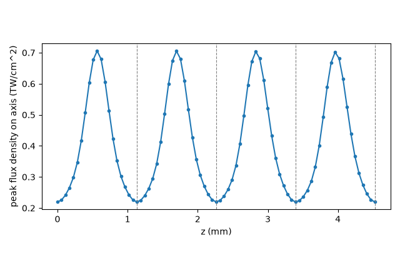
Spatiotemporal propagation in a graded-index multimode fibre
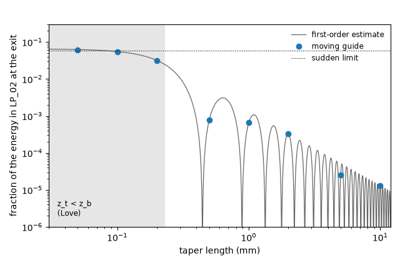
A tapered graded-index fibre: adiabatic and abrupt mode conversion
Performance#
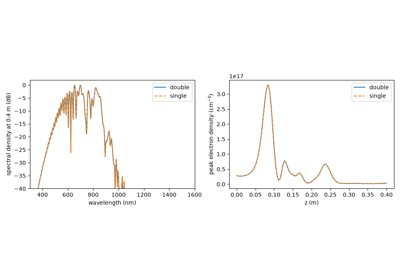
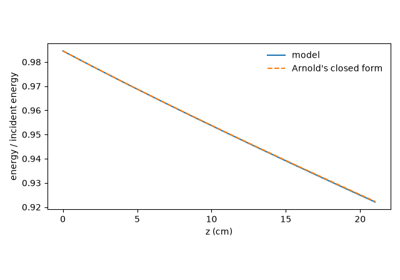
Running the same physics faster or in less memory: single precision on an Apple GPU, compared with binary64.