Note
Go to the end to download the full example code.
The vector wall: two impedances, two families, one conversion#
The scalar coherent wall gives the glass one impedance, the average a linearly
polarised HE_1m field sees around the bore. The wall imposes two conditions, not
one: at grazing incidence the field tangential to the glass sees
d_r E = i k_o E and the field normal to it sees d_r E = i (k_o/n_r^2) E.
CoherentWall(impedance="te_tm") condenses both
(Vector boundary response). Because the wall is rotationally symmetric the
total
azimuthal order nu is conserved, and an order has at most two radial families,
so the block is one order’s two families: TE_0m and TM_0m for nu = 0,
HE_nu,m and EH_nu,m for nu >= 1.
This example shows the two things a vector wall adds, each with the number the run should reproduce:
each family keeps its own loss.
TE_01andTM_01of a 125 um bore at 800 nm lose0.1161and0.24401/m – a factorepsof the silica wall apart, which no impedance-averaged block can produce (it gives both0.1800);the anisotropy couples the two hybrid families. Ten fixed steps of a 50 um bore, launched into
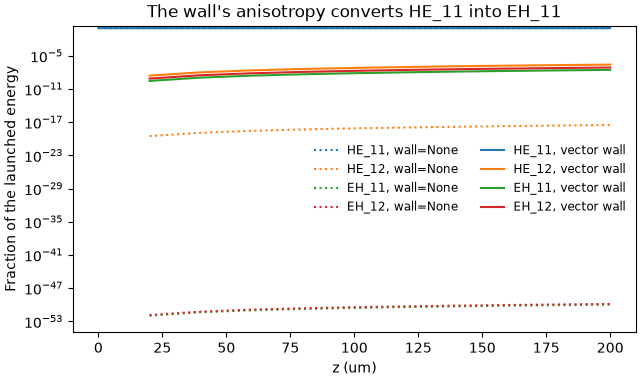
HE_11, leave2.8e-8of the arriving energy inEH_11, where the uncoupled route leaves nothing measurable, and the transfer scales as the square of the half-differencedeltaof the two impedances.
The approximation, in one sentence: this is the scalar block’s quasi-static, paraxial condensation applied to the grazing-impedance model of the wall, checked against the exact vector Maxwell roots family by family (to the size of this package’s own Marcatili error) and through the coupled eigenvalue; it has not yet been checked against a resolved-cladding Maxwell solve excited in a mixed-family state.
import warnings

import matplotlib.pyplot as plt
import numpy as np

from solprop.boundaries import absorber
from solprop.constants import C
from solprop.driver import prop_capillary
from solprop.grid import FieldGrid
from solprop.modes import CoherentWall, MarcatiliMode, vector_wall_operator
from solprop.stepper import FixedSchedule
Each family’s own loss, without a run#
One channel of each family, alone, in an evacuated 125 um bore with a silica-like
wall of index 1.45. A negative azimuthal index is this package’s spelling of the
EH family. The vector block’s decay rate of each is set beside this package’s
own Marcatili rate for the same channel, and beside what an impedance-averaged
block would give the two transverse families: the same channel with the hybrid
cladding term v_HE = (v_TE + v_TM)/2 in place of its own.
radius, wavelength = 125e-6, 800e-9
omega = np.array([2.0 * np.pi * C / wavelength])
families = {
    "TE_01": ("TE", 0),
    "TM_01": ("TM", 0),
    "HE_11": ("HE", 1),
    "EH_11": ("HE", -1),
}
cladding = 1.45 + 0j


def cladding_term(kind, order):
    """Return this package's Marcatili cladding term `v_n` for one family."""
    mode = MarcatiliMode(radius, None, 0.0, kind=kind, n=order, cladding=cladding)
    return complex(mode.sampled_terms(omega).cladding_term[0])


hybrid = cladding_term("HE", 1)
rows = {}
for name, (kind, order) in families.items():
    mode = MarcatiliMode(radius, None, 0.0, kind=kind, n=order, m=1, cladding=cladding)
    block = vector_wall_operator([mode], omega, validity_limit=2.0)
    vector = -float(np.real(block.generator[0, 0, 0]))
    marcatili = float(np.imag(mode.neff(omega)[0]) * omega[0] / C)
    averaged = marcatili * hybrid.real / cladding_term(kind, order).real
    rows[name] = (vector, marcatili, averaged)
    print(
        f"{name}: vector block {vector:.6e} 1/m, Marcatili {marcatili:.6e}, "
        f"impedance-averaged {averaged:.4e}"
    )
print(
    f"TM_01 / TE_01 = {rows['TM_01'][0] / rows['TE_01'][0]:.4f}, "
    f"eps = {cladding.real**2:.4f}"
)

fig, ax = plt.subplots(figsize=(6.4, 3.4), constrained_layout=True)
positions = np.arange(len(rows))
ax.bar(positions - 0.2, [row[0] for row in rows.values()], 0.4, label="vector block")
ax.bar(
    positions + 0.2, [row[2] for row in rows.values()], 0.4, label="impedance averaged"
)
ax.plot(
    positions, [row[1] for row in rows.values()], "k_", markersize=28, label="Marcatili"
)
ax.set_xticks(positions, list(rows))
ax.set(
    ylabel="Field-loss rate (1/m)", title="125 um bore, 800 nm: each family's own loss"
)
ax.legend(fontsize="small", frameon=False)
plt.show()
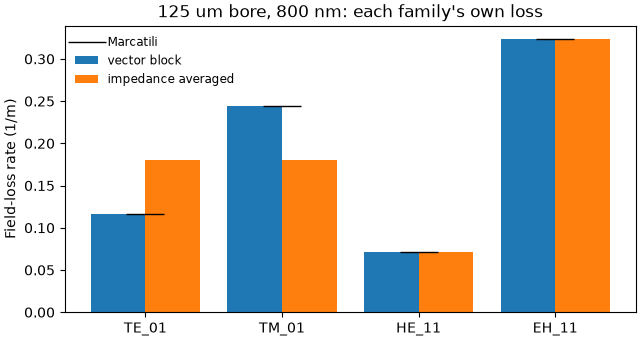
TE_01: vector block 1.160597e-01 1/m, Marcatili 1.160616e-01, impedance-averaged 1.8004e-01
TM_01: vector block 2.440085e-01 1/m, Marcatili 2.440195e-01, impedance-averaged 1.8004e-01
HE_11: vector block 7.091628e-02 1/m, Marcatili 7.091713e-02, impedance-averaged 7.0917e-02
EH_11: vector block 3.234098e-01 1/m, Marcatili 3.234259e-01, impedance-averaged 3.2343e-01
TM_01 / TE_01 = 2.1024, eps = 2.1025
The conversion, through the entry point#
The order nu = 1, two channels of each family: HE_11, HE_12, EH_11,
EH_12, contiguous from m = 1 in each. A supplied mode set is the run’s
geometry, so prop_capillary’s own radius argument must agree with the modes’
radius or the call is refused by name; the two are the same here.
Ten fixed steps of 20 um, launched into HE_11, with the vector wall and with
the ordinary incoherent loss. The scalar block cannot carry this set at all – it
spans two families – and is refused by name.
length, steps = 2e-4, 10
bore = 50e-6
grid = FieldGrid.from_limits(length, 800e-9, (400e-9, 1.6e-6), 300e-15)


def run(wall, modes):
    """Propagate `modes` ten fixed steps of the 50 um bore, with or without a wall."""
    # A marginal geometry on purpose, and a band past the fitted ranges: both warn.
    with warnings.catch_warnings():
        warnings.simplefilter("ignore")
        return prop_capillary(
            bore,
            length,
            "He",
            1.0,
            lambda0=800e-9,
            grid=grid,
            absorber=absorber(grid, boundary_length=1e3),
            fwhm=30e-15,
            energy=1e-9,
            modes=modes,
            n_save=11,
            backend="numpy_ref",
            wall=wall,
            schedule=FixedSchedule(np.full(steps, length / steps)),
            dz_max=length / steps,
            dz_init=length / steps,
            plasma=False,
            raman=False,
            progress="none",
        )


order_one = [
    MarcatiliMode(bore, "He", 1.0, n=order, m=radial + 1)
    for order in (1, -1)
    for radial in range(2)
]
labels = ["HE_11", "HE_12", "EH_11", "EH_12"]
walled = run(CoherentWall(impedance="te_tm"), order_one)
plain = run(None, order_one)
flow = walled.metadata.modal["flow"]
print(flow["model"], "|", walled.metadata.modal["basis"], "|", flow["gauge_id"])


def channel_energy(output, count):
    """Return the positions and the energy in each channel at every save plane."""
    planes = output.planes()
    energy = np.array(
        [np.asarray(plane.stats["energy"]).reshape(count, -1)[:, 0] for plane in planes]
    )
    return np.array([plane.z for plane in planes]), energy


_, energy = channel_energy(walled, 4)
print(
    f"vector wall: energy lost {1.0 - energy[-1].sum() / energy[0].sum():.6e}, "
    f"EH_11 holds {energy[-1, 2] / energy[-1].sum():.4e} of what arrives"
)
te_tm impedance coherent wall | capillary azimuthal order | capillary azimuthal order nu=1
vector wall: energy lost 4.419805e-04, EH_11 holds 2.8453e-08 of what arrives
The conversion is the anisotropy’s. Moving the cladding index from 1.45 to 1.2099
shrinks delta, the half-difference of the two impedances, by a factor 1.54;
a coupling through delta must shrink the EH_11 share by that squared.
ratios = []
for index in (1.45 + 0j, 1.2099 + 0j):
    pair = [
        MarcatiliMode(bore, "He", 1.0, n=order, m=1, cladding=index)
        for order in (1, -1)
    ]
    block = vector_wall_operator(pair, grid.omega, active=grid.active_mask)
    impedance = block.impedance[:, grid.active_mask]
    delta = float(np.max(np.abs(0.5 * (impedance[0] - impedance[1]))))
    field = run(CoherentWall(impedance="te_tm"), pair).planes()[-1].field[:, 0]
    share = np.sum(np.abs(field) ** 2, axis=-1)
    ratios.append((delta, float(share[1] / share[0])))
(delta_a, share_a), (delta_b, share_b) = ratios
print(
    f"delta shrinks by {delta_a / delta_b:.4f}; "
    f"the EH_11 share by {share_a / share_b:.6f} "
    f"against delta squared, {(delta_a / delta_b) ** 2:.6f}"
)

fig, ax = plt.subplots(figsize=(6.4, 3.8), constrained_layout=True)
for output, style, name in ((plain, ":", "wall=None"), (walled, "-", "vector wall")):
    z, energy = channel_energy(output, 4)
    shares = energy / energy[0, 0]
    shares = np.where(shares > 0.0, shares, np.nan)
    for channel in range(4):
        ax.semilogy(
            z * 1e6,
            np.maximum(shares[:, channel], 1e-60),
            style,
            color=f"C{channel}",
            label=f"{labels[channel]}, {name}",
        )
ax.set(
    xlabel="z (um)",
    ylabel="Fraction of the launched energy",
    title="The wall's anisotropy converts HE_11 into EH_11",
    ylim=(1e-55, 3.0),
)
ax.legend(frameon=False, fontsize="small", ncol=2)
plt.show()
/home/docs/checkouts/solprop/checkouts/24/docs/tutorials/capillaries/plot_09_vector_wall.py:192: GrazingIncidenceWarning: the coherent wall block's quasi_static reaches 0.08095, within a factor ten of the 0.25 limit; the condensed paraxial model is marginal over this band
  block = vector_wall_operator(pair, grid.omega, active=grid.active_mask)
/home/docs/checkouts/solprop/checkouts/24/docs/tutorials/capillaries/plot_09_vector_wall.py:192: GrazingIncidenceWarning: the coherent wall block's quasi_static reaches 0.08689, within a factor ten of the 0.25 limit; the condensed paraxial model is marginal over this band
  block = vector_wall_operator(pair, grid.omega, active=grid.active_mask)
delta shrinks by 1.5417; the EH_11 share by 2.377524 against delta squared, 2.376805