Nonlinear processes in gas-filled hollow-core fibres#
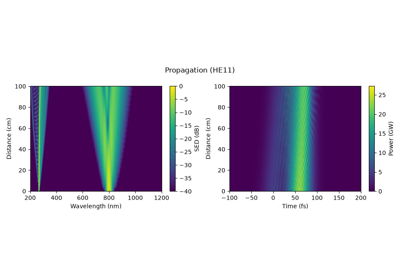
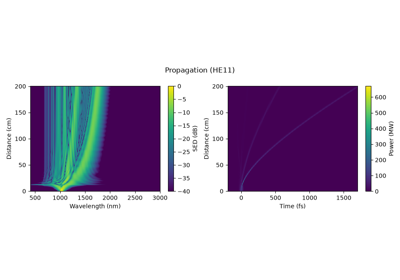
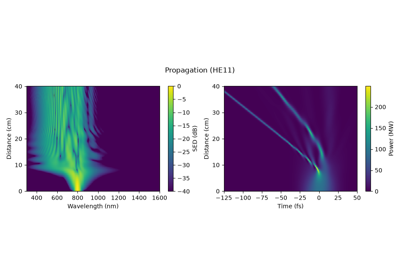
One process per example – self-phase modulation, soliton self-compression and dispersive-wave emission, four-wave mixing, cross-phase modulation, Raman and photoionisation-induced soliton frequency shifts – each a single deterministic run with the parameters of the survey figure in J. C. Travers, T. Grigorova, C. Brahms and F. Belli’s review of nonlinear optics in gas-filled hollow-core fibres, headed by the vacuum-ultraviolet dispersive wave that illustrates this package’s README. The last two compare the electronic responses of A frequency-dependent electronic response at full size: the helium dispersive wave, with one, two and four modes, and deep-ultraviolet four-wave mixing in argon over a pressure scan.
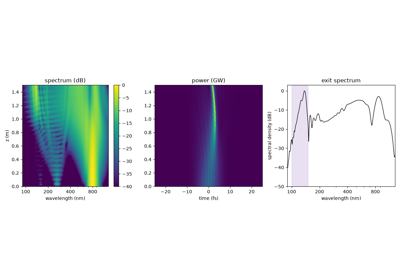
Vacuum-ultraviolet dispersive-wave emission in a gas-filled capillary
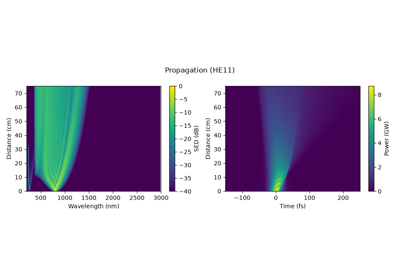
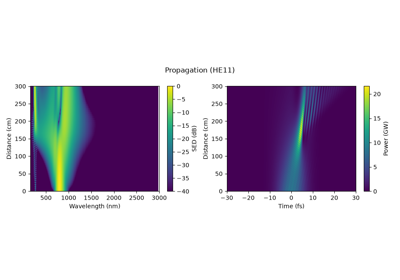
Soliton self-compression and ultraviolet dispersive-wave emission
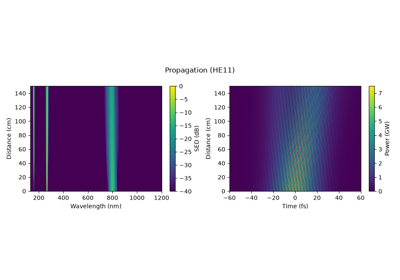
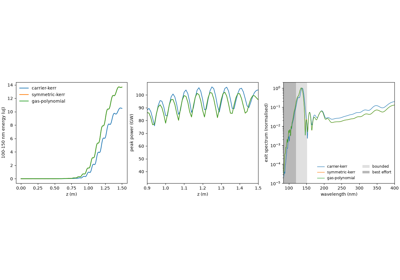
The vacuum-ultraviolet dispersive wave under a frequency-dependent Kerr response
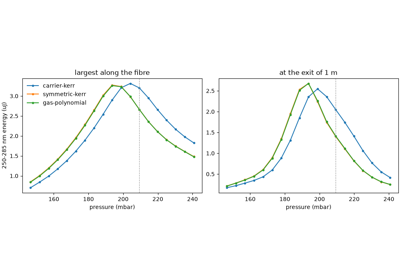
Deep-ultraviolet four-wave mixing in argon under a frequency-dependent Kerr response