Note
Go to the end to download the full example code.
Compare material choices#
The default material data for gases, solids, Raman responses and ionisation
rates come from the curated library optmat
(SEP 3): a run
with no materials= takes MaterialSelection(), optmat’s recommended model of
each family. This tutorial shows how to see what a run resolved, how to declare a
different material, and how to tell which part of the physics a change touches.
It resolves and inspects optmat’s models of argon, their identities, statuses and
uncertainty; modifies one of them with optmat’s own with_parameters; and runs a
short, 0.4 mm argon capillary with plasma (ten fixed steps, about a second each) once
on the defaults and once for each of three declared changes: another gas index,
a modified ionisation rate and a wall of the caller’s own Sellmeier glass. A table
separates what each change touched – dispersion, electronic (Kerr) coefficient, Raman
response, ionisation rate and solid index – by reading the runs’ material manifests.
The guide is far too short to be a physical prediction; it ranks the changes. See Materials: gases, metals and glasses for the full selection guide.
import warnings
from time import perf_counter

import matplotlib.pyplot as plt
import numpy as np
from optmat.gas.ionisation_rates import ionisation_rate_model

from solprop.boundaries import absorber
from solprop.constants import C
from solprop.driver import prop_capillary
from solprop.grid import FieldGrid
from solprop.nonlinear.optmat_raman import raman_status
from solprop.nonlinear.optmat_rates import OptmatRate
from solprop.physdata import MaterialSelection, SellmeierGlass, fused_silica, species
from solprop.stepper import FixedSchedule

started = perf_counter()
What optmat resolves#
A built-in species carries optmat’s models, each with an identity: a name, a status
and a SHA-256 digest that changes whenever the model’s numbers can. The status says
how far optmat vouches for it (validated, provisional, untested,
comparison for a curated alternative, user for a caller’s override).
argon = species("Ar")
silica = fused_silica()
for item in (*argon.material_records, *silica.material_records):
    print(f"{item.kind:24s} {item.name:24s} {item.status:10s} {item.digest:.12}")

rate = OptmatRate("Ar", 800e-9)
print(
    f"\nionisation: {rate.optmat_model.identity.name}, {rate.status}, "
    f"uncertainty factor {rate.uncertainty_factor}, "
    f"zero below {rate.threshold:.2e} V/m, held above {rate.maximum_field:.2e} V/m"
)
print("Raman:", {gas: raman_status(gas) for gas in ("Ar", "N2", "H2", "N2O")})
gas_refractive           fit/Ar                   validated  f0efa785e42d
equation_of_state        eos/Ar                   validated  85ee5c2688ac
transport                transport/Ar             validated  1054ed95ba27
gas_hyperpolarizability  hyperpolarizability/Ar   validated  d15700d61f7a
solid                    fit/SiO2                 validated  93e901d77368

ionisation: rate/default/Ar@800nm, validated, uncertainty factor 1.5, zero below 1.19e+08 V/m, held above 8.62e+10 V/m
Raman: {'Ar': 'atom', 'N2': 'validated', 'H2': 'validated', 'N2O': 'provisional'}
A quick experiment#
optmat’s with_parameters modifies a curated model without touching optmat. The
result is status user, lists what changed and keeps the digest of the model it
started from, so a run’s record says exactly what was declared. Here argon’s rate
with two effective electrons in place of one: twice the rate, at every field.
curated = ionisation_rate_model("Ar", 800e-9)
doubled = curated.with_parameters(electrons=2.0)
identity = doubled.identity
print(identity.status, identity.modified, identity.base == curated.identity.digest)
field = np.array([2e10, 4e10])
print("rate ratio:", OptmatRate(doubled)(field) / rate(field))
user (('electrons', '2.0'),) True
rate ratio: [2. 2.]
One short run, four material choices#
A 50 um-radius, 0.4 mm argon capillary at 1 bar with a 30 fs, 100 uJ pulse at 800 nm and plasma on: the parameters, grid and ten fixed steps of the archived witness. The absorbing collar is lengthened, as the witness’s was, because the default collar of so short a guide is too stiff for ten fixed steps.
LENGTH = 4e-4
GRID = FieldGrid.from_limits(LENGTH, 800e-9, (160e-9, 4e-6), 600e-15)


def run(**choices):
    """Propagate the witness capillary with the given material keywords."""
    with warnings.catch_warnings():
        # The padded grid reaches beyond every model's qualified range; each run says
        # so once (MaterialRangeWarning), which is not this tutorial's point.
        warnings.simplefilter("ignore")
        return prop_capillary(
            50e-6,
            LENGTH,
            "Ar",
            1.0,
            lambda0=800e-9,
            grid=GRID,
            absorber=absorber(GRID, boundary_length=1.0),
            fwhm=30e-15,
            energy=1e-4,
            plasma=True,
            schedule=FixedSchedule(np.full(10, LENGTH / 10)),
            n_save=2,
            backend="numpy_ref",
            progress=None,
            **choices,
        )


malitson = SellmeierGlass(
    name="SiO2",
    source="malitson",
    wavelength_range=(210e-9, 3.71e-6),
    citation="I. H. Malitson, J. Opt. Soc. Am. 55, 1205 (1965), relative to air",
    poles=((0.6961663, 0.0684043), (0.4079426, 0.1162414), (0.8974794, 9.896161)),
)
runs = {
    "default": run(),
    "Borzsonyi's argon index": run(
        materials=MaterialSelection(linear="borzsonyi_2008/sellmeier_Ar")
    ),
    "argon rate, two electrons": run(materials=MaterialSelection(ionisation=doubled)),
    "Malitson's silica wall": run(cladding=malitson),
}
Which family each change touched#
A run’s material manifest lists every optmat model it used, by kind, and the citation of every material object the caller supplied. Comparing two manifests kind by kind says which family a change reached, whatever the change was declared as. The other columns are the change of the output: the spectrum’s relative change in norm, and the ionised fraction and peak power at the exit.
FAMILIES = {
    "dispersion": ("gas_refractive",),
    "electronic": ("gas_hyperpolarizability",),
    "Raman": ("raman_response",),
    "ionisation": ("ionisation_rate",),
    "solid index": ("solid",),
}
SOLID_OBJECTS = ("SellmeierGlass", "TabulatedGlass", "CompositeGlass")


def used(output, family):
    """Return what a run used for one family: its models and supplied solids."""
    manifest = output.metadata.materials
    models = {
        (record.name, record.digest)
        for record in manifest.records
        if record.kind in FAMILIES[family]
    }
    if family == "solid index":
        models |= {
            (entry["object"], entry["citation"])
            for entry in manifest.citations
            if entry["object"] in SOLID_OBJECTS
        }
    return models


def exit_values(output):
    """Return the exit plane's stored spectrum, ionised fraction and peak power."""
    spectrum = output.planes()[-1].field
    electrons = float(np.sum(output["stats/electron_density"][-1]))
    density = float(np.sum(output["stats/density"][-1]))
    power = float(np.max(output["stats/peak_power"][-1]))
    stored = np.ascontiguousarray(spectrum, dtype=np.complex128)
    return stored, electrons / density, power


reference, reference_fraction, reference_power = exit_values(runs["default"])
print(f"{'declared change':26s}" + "".join(f"{name:>12s}" for name in FAMILIES))
for label, output in runs.items():
    if label == "default":
        continue
    touched = [
        "changed" if used(output, family) != used(runs["default"], family) else "-"
        for family in FAMILIES
    ]
    print(f"{label:26s}" + "".join(f"{mark:>12s}" for mark in touched))
print()
print(f"{'declared change':26s}{'spectrum':>10s}{'ionised':>10s}{'peak P':>10s}")
for label, output in runs.items():
    spectrum, fraction, power = exit_values(output)
    change = np.linalg.norm(spectrum - reference) / np.linalg.norm(reference)
    print(
        f"{label:26s}{change:10.1e}{fraction / reference_fraction - 1:+10.2%}"
        f"{power / reference_power - 1:+10.2%}"
    )
declared change             dispersion  electronic       Raman  ionisation solid index
Borzsonyi's argon index        changed           -           -           -           -
argon rate, two electrons            -           -           -     changed           -
Malitson's silica wall               -           -           -           -     changed

declared change             spectrum   ionised    peak P
default                      0.0e+00    +0.00%    +0.00%
Borzsonyi's argon index      1.8e-04    +0.01%    -0.00%
argon rate, two electrons    1.4e-01   +76.88%    -1.93%
Malitson's silica wall       8.1e-08    -0.00%    -0.00%
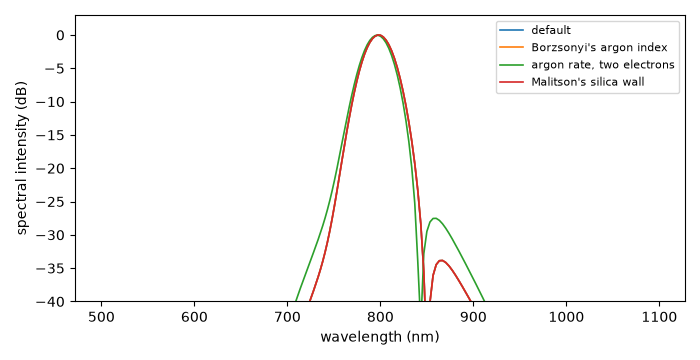
The rate dominates: twice the rate raises the ionised fraction at the exit by three quarters and changes the spectrum by more than ten per cent. Another gas index changes it by parts in ten thousand, almost all of it one constant phase of the carrier, and a wall of another silica by parts in ten million: the light barely reaches the wall of a 50 um core in 0.4 mm.
The figure compares the exit spectra.
omega = GRID.omega
band = (omega > 2 * np.pi * C / 1100e-9) & (omega < 2 * np.pi * C / 500e-9)
wavelength = 2 * np.pi * C / omega[band]
peak = np.max(np.abs(reference.ravel()[band]) ** 2)


def decibels(spectrum):
    """Return a stored spectrum's intensity in dB relative to the default's peak."""
    return 10 * np.log10(np.abs(spectrum.ravel()[band]) ** 2 / peak + 1e-30)


fig, ax = plt.subplots(figsize=(7.0, 3.6))
for label, output in runs.items():
    ax.plot(wavelength * 1e9, decibels(exit_values(output)[0]), lw=1.2, label=label)
ax.set_xlabel("wavelength (nm)")
ax.set_ylabel("spectral intensity (dB)")
ax.set_ylim(-40, 3)
ax.legend(fontsize=8)
fig.tight_layout()
plt.show()

print(f"run time {perf_counter() - started:.1f} s")
run time 2.4 s