Note
Go to the end to download the full example code.
Four-wave mixing into the vacuum ultraviolet#
Two pulses of different colours travelling together through a gas-filled capillary mix through the third-order susceptibility. In degenerate four-wave mixing two pump photons are converted into a seed photon and an idler photon, \(2\omega_p = \omega_s + \omega_i\). With a deep-ultraviolet pump at 267 nm (the third harmonic of a titanium-sapphire laser) and its 800 nm fundamental as the seed, the idler is at
in the vacuum ultraviolet. The process is efficient only if it is phase matched: the waveguide’s anomalous contribution to the dispersion must cancel the gas’s normal contribution, so that \(2\beta(\omega_p) = \beta(\omega_s) + \beta(\omega_i)\); this is achieved by choosing the gas pressure for the capillary’s core size. Because the capillary keeps the beams overlapped and the interaction length long, a large fraction of the pump energy can be converted to the vacuum ultraviolet in a single pass – up to the photon-number limit \(\omega_i / 2\omega_p \approx 0.83\) of it, since every idler photon costs two pump photons.
This example launches two pulses at once with pulses=[...]: a 35 fs, 95 uJ pump
at 267 nm and a 35 fs, 45 uJ seed at 800 nm, into 1.5 m of 75 um-radius capillary filled
with helium at 0.445 bar. The grid’s reference wavelength is the pump’s.
What to look for. In the spectrum, the idler appears near 160 nm and grows along the fibre while the pump and seed exchange energy with it; cross-phase modulation broadens the seed. In time, the pump and the seed walk off from each other slowly, which limits how long they can mix. At the exit about 44 % of the pump energy is in the idler. Phase matching is sharp. This example’s original set-up used 0.48 bar; the pressure moved to 0.445 bar because optmat’s helium index (SEP 3) puts the linear phase matching of this capillary at 0.457 bar, and the pump’s Kerr phase moves the exit optimum to 0.445 bar. At 0.48 bar the idler would now carry under a tenth of the pump.
What is approximate. Only the fundamental mode is carried. The helium index is optmat’s fit, qualified over the whole band (from 60 nm).
This is panel (c) of the survey of nonlinear processes in the review by Travers et al.; the experiment it is based on is reported by Forbes et al., Optics Letters 49 (2024).
Use phase-matching tools to locate a starting pressure, then refine the nonlinear calculation around it. The frequency-dependent Kerr chapter explains the carrier-coefficient approximation used here.
The run#
import time
import warnings

import matplotlib.pyplot as plt
import numpy as np

from solprop.driver import prop_capillary
from solprop.exceptions import MaterialRangeWarning
from solprop.plotting import prop_2d, spec_1d, time_1d
from solprop.processing import bandpass, energy, grid_of
from solprop.pulses import GaussianPulse

pump = GaussianPulse(wavelength=267e-9, fwhm=35e-15, energy=95e-6)
seed = GaussianPulse(wavelength=800e-9, fwhm=35e-15, energy=45e-6)
idler_wavelength = 1 / (2 / pump.wavelength - 1 / seed.wavelength)
print(f"idler at {idler_wavelength * 1e9:.1f} nm")

started = time.perf_counter()
with warnings.catch_warnings():
    warnings.simplefilter("ignore", MaterialRangeWarning)
    run = prop_capillary(
        75e-6,
        1.5,
        "He",
        0.445,
        lambda0=267e-9,
        pulses=[pump, seed],
        trange=400e-15,
        wavelength_limits=(120e-9, 3e-6),
        n_save=301,
        progress="none",
    )
idler at 160.2 nm
Spectral and temporal evolution#
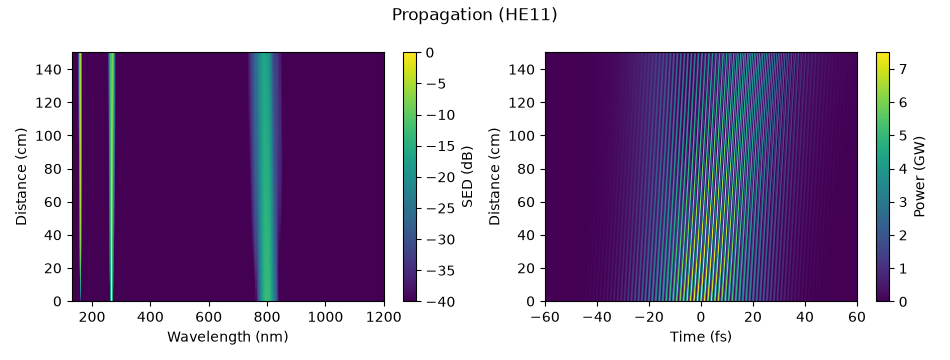
The idler#
The energy in a band around the idler along the fibre, and the input and output spectra.
idler = bandpass(grid_of(run), (150e-9, 170e-9))
z = np.asarray(run["z"])
idler_energy = np.asarray(
    [float(np.sum(energy(run, plane=index, bandpass=idler))) for index in range(z.size)]
)

fig, (left, right) = plt.subplots(1, 2, figsize=(10.0, 3.6))
left.plot(z, idler_energy * 1e6)
left.set_xlabel("z (m)")
left.set_ylabel("150-170 nm energy (uJ)")
spec_1d(run, z=[0.0, 1.5], ax=right, wavelength_range=(130e-9, 1e-6))
fig.tight_layout()

launched = float(np.sum(energy(run, plane=0)))
print(
    f"idler at the exit {idler_energy[-1] * 1e6:.2f} uJ, "
    f"{idler_energy[-1] / (pump.energy or 1.0):.2%} of the pump energy; "
    f"launched {launched * 1e6:.0f} uJ in all"
)
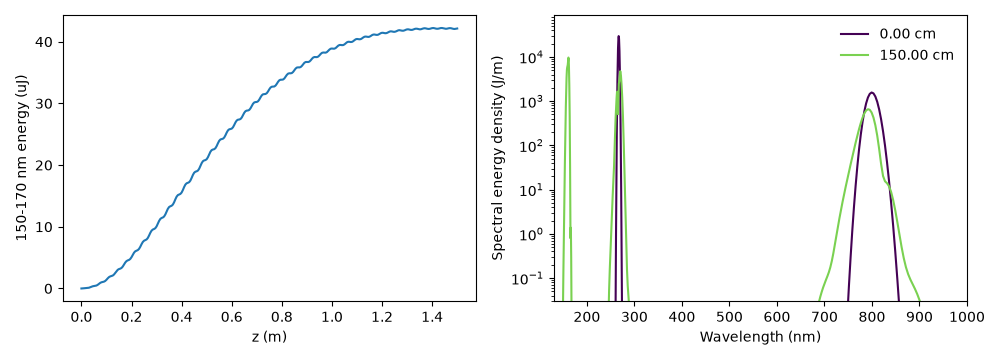
idler at the exit 42.14 uJ, 44.35% of the pump energy; launched 140 uJ in all
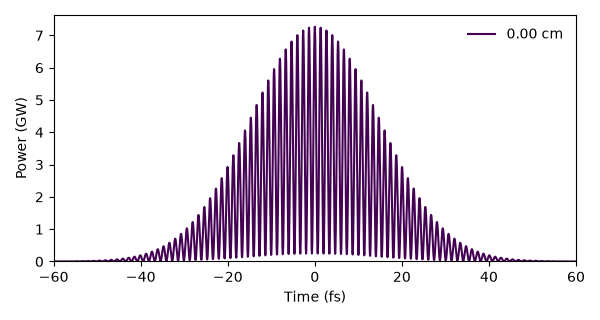
The two input pulses in time, as launched. Their coherent power beats at the difference frequency. The width of one beat is not the 35 fs duration of either input pulse, so the automatic single-peak width label is disabled.
fig, ax = plt.subplots(figsize=(6.0, 3.2))
time_1d(run, z=0.0, trange=(-60e-15, 60e-15), widths=False, ax=ax)
fig.tight_layout()
Runtime and reproducibility#
print(f"{time.perf_counter() - started:.0f} s; backend {run.metadata.backend.name}")
9 s; backend native
Total running time of the script: (0 minutes 8.585 seconds)