Note
Go to the end to download the full example code.
A declared basis of a split pair: two bases, one answer#
A guide’s channels arrive in whatever basis its provider solved them in. Any unitary
combination of a block is as good a basis, but U^H diag(beta) U is diagonal only
where the block’s propagation constants are equal, and every “degenerate” group of a
real guide is split by something. Declare a basis over a split pair and the
rotated channel amplitudes beat. The general modal route propagates the
full coupled linear operator in that basis; see Circular and coupled modal bases.
The pair here is the retained half of the weak-guidance LP_11 group of a
step-index core of 6 um radius: TE_01 and TM_01, degenerate under weak guidance
and split by the vector correction, by 120 1/m at 835 nm – 1.1e-5 of their own
propagation constants. An equal-weight rotation of them puts the whole splitting in the
leaf’s off-diagonal: |G_01| is half the splitting, about 60 1/m at 835 nm.
What this example checks:
the two bases agree on one launch. A pure rotated channel is the superposition
U[:, 0]of the provider’s own channels, so the plain basis reproduces the same physical launch as a combination of two of its own runs; carried back throughU^Hit must be the rotated run. The two share no execution path below the guide – one is a coupled matrix flow, the other two diagonal exponentials – and agree to8.4e-6in each channel’s modulus and2.1e-5rad in the phase between them, inside the grid’s declared window;the flow moves power. Over a millimetre a launch into one rotated channel arrives with
3.8e-3of it in the other, which issin^2(|G_01| z)of the block’s own off-diagonal to about one per cent – the grid’s temporal-window absorber, a convolution in frequency, attenuates the two channels’ different spectra differently, and contributes to the difference. Agreement is assessed at finite frequency, interpolation and stepping resolution.
The approximation, in one sentence: none is added to the propagation – the
coupled flow is the same linear physics in other coordinates – but a rotated
channel’s neff is the block’s mean propagation constant, which is what the
surrogate area and the labels need and is not what the channel propagates with,
because it beats. This per-channel index is a surrogate, and a known limitation of a
coupled block; for the same reason the route withholds zdw on one.
import matplotlib.pyplot as plt
import numpy as np

from solprop.constants import C
from solprop.driver import Simulation
from solprop.grid import FieldGrid
from solprop.modes import IndexMaterial, MaterialRegion, ModalGuide, StepIndexMode
from solprop.modes.guide import ChannelBasis
from solprop.modes.protocol import ChannelLabel
The guide, twice#
A 6 um silica-like core in a 1.40 cladding, and its two LP_11 members of
azimuthal order zero. Both regions are linear – this example is about the linear
flow, and a guide whose regions declare no response skips the source pass
entirely. The knots cover the grid’s whole active band, which is about twice the
declared one; seventeen of them, because the splitting is a small difference of
two large propagation constants and reproducing it between the knots costs more
of them than reproducing either.
length = 1e-3
grid = FieldGrid.from_limits(length, 835e-9, (815e-9, 860e-9), 60e-15)
core, cladding = IndexMaterial(1.45), IndexMaterial(1.40)
pair = tuple(
    StepIndexMode(
        6e-6,
        core=1.45,
        cladding=1.40,
        profile_wavelength=835e-9,
        kind=kind,
        n=0,
        m=1,
        parity="even",
    )
    for kind in ("TE", "TM")
)
regions = (
    MaterialRegion("core", 0.0, pair[0].core_radius, core),
    MaterialRegion("cladding", pair[0].core_radius, None, cladding),
)
provider = ModalGuide.from_step_index(
    pair, core=core, cladding=cladding, regions=regions
).field_provider

root = 1.0 / np.sqrt(2.0)
basis = ChannelBasis(
    np.array([[root, -root], [root, root]], dtype=complex),  # a quarter turn
    ((0, 1),),  # the block it acts in
    (
        ChannelLabel("LP", 1, 1, "even", None, "LP1,1:even"),
        ChannelLabel("LP", 1, 1, "odd", None, "LP1,1:odd"),
    ),
    "lp11(0,1)",
)
active = grid.omega[grid.active_mask]
knots = np.linspace(0.99 * float(active[0]), 1.01 * float(active[-1]), 17)
nodes = provider.node_rule(0.99 * float(active[0]), n_r=24)
rotated, plain = (
    ModalGuide.from_provider(
        provider, knots, nodes=nodes, degenerate_blocks=((0, 1),), basis=declared
    )
    for declared in (basis, None)
)

omega0 = np.array([float(grid.omega0)])
for name, guide in (("provider's own", plain), ("rotated", rotated)):
    indices = [
        float(np.real(mode.neff(omega0)[0])) for mode in guide.mode_collection.modes
    ]
    print(f"{name:15s} channels' neff: " + ", ".join(f"{one:.12f}" for one in indices))
provider's own  channels' neff: 1.447784077518, 1.447768125380
rotated         channels' neff: 1.447776101449, 1.447776101449
The rotated channels report one and the same neff: the block’s mean, which is
not a propagation constant of either.
Three runs of a millimetre in ten steps on numpy_ref (numba_cpu and the
native backend execute the leaf too): the rotated guide launched into its first
channel, and the plain guide launched into each of its two.
steps = 10
pulse = {
    "lambda0": 835e-9,
    "fwhm": 20e-15,
    "energy": 1e-12,
    "pulseshape": "gauss",
    "backend": "numpy_ref",
    "n_save": 11,
    "dz_max": length / steps,
    "dz_init": length / steps,
}


def simulation(guide, channel):
    """Return a one-millimetre simulation of `guide` launched into `channel`."""
    return Simulation.from_waveguide(
        (), length, provider=guide, grid=grid, channel=channel, **pulse
    )


turned = simulation(rotated, 0)
problem = turned.translate()
turned_out = turned.run()
plain_out = [simulation(plain, channel).run() for channel in (0, 1)]
flow = turned_out.metadata.modal["flow"]
print(
    flow["model"],
    flow["section_methods"],
    f"largest coupling {flow['largest_coupling']}",
)
declared channel basis ['constant_schur'] largest coupling 183.849
The comparison, plane by plane, inside the declared 815–860 nm window: outside it the grid carries the absorbing collar, which two guides with different index tables carry differently, and the same comparison reads 1e-3 there.
low, high = (2.0 * np.pi * C / one for one in (860e-9, 815e-9))
window = (grid.omega >= low) & (grid.omega <= high)
matrix = basis.transform
block = problem.linear.coupled_flow.generator[0, 0]
z = np.array([plane.z for plane in turned_out.planes()])


def both_bases(index):
    """Return plane `index` of the rotated run and of the plain runs carried by U^H."""
    here = turned_out.planes()[index].field[:, 0, :]
    exits = [one.planes()[index].field[:, 0, :] for one in plain_out]
    carried = matrix.conj().T @ (matrix[0, 0] * exits[0] + matrix[1, 0] * exits[1])
    return here, carried


def other_share(state):
    """Return the share of each window bin's power in the second rotated channel."""
    power = np.abs(state[:, window]) ** 2
    return power[1] / power.sum(axis=0)


pairs = [both_bases(index) for index in range(z.size)]
shares = np.array([other_share(here) for here, _ in pairs])
carried_shares = np.array([other_share(carried) for _, carried in pairs])

here, carried = pairs[-1]
modulus = max(
    float(
        np.max(np.abs(np.abs(here[row, window]) / np.abs(carried[row, window]) - 1.0))
    )
    for row in (0, 1)
)
phase = float(
    np.max(
        np.abs(
            np.angle(
                (here[1, window] / here[0, window])
                / (carried[1, window] / carried[0, window])
            )
        )
    )
)
print(f"two bases at the exit: modulus {modulus:.2e}, relative phase {phase:.2e} rad")
coupling = np.abs(block[0, 1, window])
print(
    "share in the other rotated channel at 1 mm: "
    + ", ".join(f"{one:.4e}" for one in shares[-1])
    + "; sin^2(|G_01| L): "
    + ", ".join(f"{one:.4e}" for one in np.sin(coupling * length) ** 2)
)

fig, ax = plt.subplots(figsize=(6.4, 3.6), constrained_layout=True)
fine = np.linspace(0.0, length, 101)
for column in range(shares.shape[1]):
    wavelength = 2.0 * np.pi * C / grid.omega[window][column] * 1e9
    ax.plot(
        fine * 1e3,
        np.sin(coupling[column] * fine) ** 2,
        "--",
        color=f"C{column}",
        linewidth=0.8,
        label=rf"$\sin^2(|G_{{01}}|z)$ at {wavelength:.0f} nm",
    )
    ax.plot(
        z * 1e3,
        shares[:, column],
        "o",
        color=f"C{column}",
        label=f"rotated basis, {wavelength:.0f} nm",
    )
    ax.plot(z * 1e3, carried_shares[:, column], "x", color="k", markersize=5)
ax.plot([], [], "x", color="k", label="provider's basis, carried through U^H")
ax.set(
    xlabel="z (mm)",
    ylabel="Share in the other rotated channel",
    title="A split pair in a rotated basis beats; both bases say so",
)
ax.legend(fontsize="small", frameon=False)
plt.show()
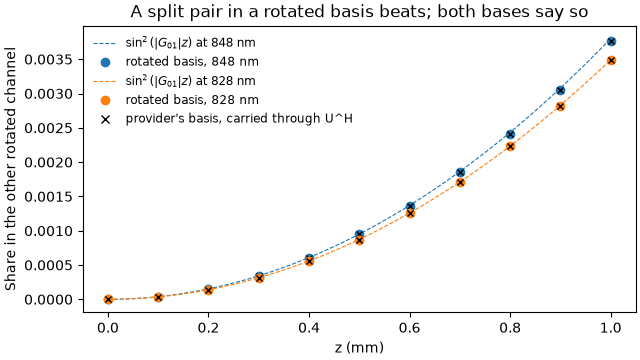
two bases at the exit: modulus 8.45e-06, relative phase 2.09e-05 rad
share in the other rotated channel at 1 mm: 3.7668e-03, 3.4873e-03; sin^2(|G_01| L): 3.8014e-03, 3.4914e-03