Note
Go to the end to download the full example code.
Scan helium pressure and pulse energy#
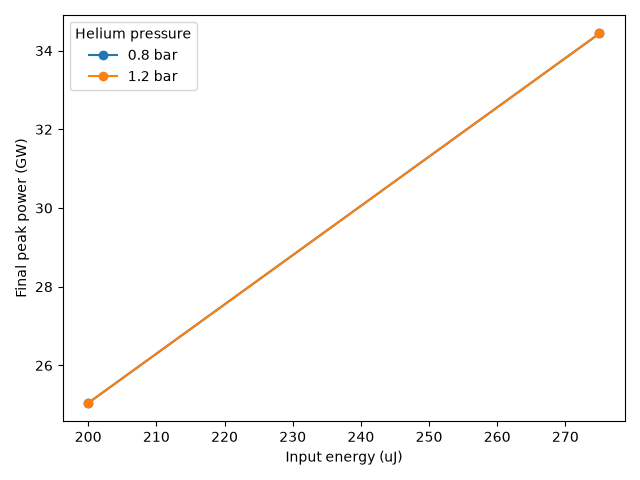
A reduced version of a resonant-dispersive-wave (RDW) set-up shows how to vary pressure and energy together and collect a compact result from each run. Point indices make the scan reproducible, while shared setup and per-worker reductions control its execution cost. The 125 um capillary and the 7.5 fs, 800 nm pulse are those of the helium RDW case of Resonant dispersive-wave propagation, but this scan uses only 2 mm of propagation, one mode and a 200 nm lower wavelength limit to keep its execution short. It is not a converged RDW prediction. The padded grid extends beyond the fitted helium and silica ranges, so MaterialRangeWarning notices are expected. Helium has no Raman response; plasma and third-harmonic generation are explicitly disabled here.
from functools import cache
from pathlib import Path
from tempfile import TemporaryDirectory
from typing import cast

import matplotlib.pyplot as plt
import numpy as np

from solprop.driver import Simulation
from solprop.driver.executors import Local
from solprop.driver.scan import Scan, ScanPoint, run_scan
from solprop.physdata import Mixture
from solprop.processing.scans import energy_in_band, peak_power
from solprop.pulses import GaussianPulse


@cache
def base() -> Simulation:
    """Translate geometry and response tables once for this worker."""
    simulation = Simulation.from_capillary(
        125e-6,
        0.002,
        Mixture.fill({"He": 1.0}, 1.0),
        lambda0=800e-9,
        wavelength_limits=(200e-9, 1.5e-6),
        trange=200e-15,
        fwhm=7.5e-15,
        energy=200e-6,
        modes=1,
        raman=False,
        plasma=False,
        thg=False,
        n_save=3,
        backend="numpy_ref",
    )
    simulation.translate()
    return simulation


def build(point: ScanPoint) -> Simulation:
    """Update pressure and input energy while retaining the same geometry."""
    mixture = Mixture.fill({"He": 1.0}, float(cast(float, point.values["pressure"])))
    pulse = GaussianPulse(
        wavelength=800e-9,
        fwhm=7.5e-15,
        energy=float(cast(float, point.values["energy"])),
    )
    return base().with_mixture(mixture).with_input(pulse)
Local is explicit so running this gallery never starts processes. In a standalone script, select Pool under the usual main guard to reuse one base per worker.
scan = Scan("helium_pressure_energy", pressure=[0.8, 1.2], energy=[200e-6, 275e-6])
with TemporaryDirectory(prefix="solprop-gallery-scan-") as directory:
    output = run_scan(
        scan,
        build,
        executor=Local(),
        output=Path(directory) / "scan.h5",
        reductions=[peak_power(), energy_in_band(250e-9, 400e-9)],
        fields="none",
        progress="none",
    )
    if not np.all(output.status == "done"):
        raise RuntimeError(f"gallery scan failed: {output.point(0)['error']}")
    powers = output.as_grid("reduced/peak_power")

figure, axis = plt.subplots()
for index, pressure in enumerate(scan.variables["pressure"]):
    axis.plot(
        scan.variables["energy"] * 1e6,
        powers[index] * 1e-9,
        "o-",
        label=f"{pressure:g} bar",
    )
axis.set(xlabel="Input energy (uJ)", ylabel="Final peak power (GW)")
axis.legend(title="Helium pressure")
figure.tight_layout()